- Dear Seekers
- Seriousness, sincerity and commitment
- Strengths, Weaknesses, Ambitions and Needs
- Light in the dark
- Competition
- Adaptability
- Dealing with crisis
- Meditation
- Coping with life
- Evolution: the obstacles
- Our Relationships
- 8 stages of evolution
- How does your Garden Grow?
- The Menopause
- Salutation to the Sun
- The Adaptable Mind
- Putting Thought into Action
Dear Seekers
Our accommodation is decorated in a way that reflects our likes, dislikes and our needs. Another reflection of our character is to what extent we keep our accommodation clean and tidy, if we make sure we have fresh air and if we have plants that are given enough water and light. In the course of a life time we move to other accommodation, even to other cities and countries. Yet there is one form of accommodation that we keep for the duration of our life, and that is the body we were given by birth. It has no need of a postcode, but you and everybody else can find it easily. Yes you are the sole occupant of your body and as such your feelings and sensations are only able to be felt by you. If you have taken the time and energy to make your accommodation clean, tidy and to conform to your notion of comfort, it would seem obvious that your life time accommodation, that is to say your body, should not only be decorated and clean on the outside, but also healthy and comfortable on the inside?

Whilst you will not be able to walk through the wall after a Holistic Yoga class, you experience a different state of consciousness!
Reconnecting
This knowledge is based upon your awareness of feelings, on the cognition of your body and according to that you take action and make decisions. But what happens if there are feelings and situations in your body that you are not aware of? The majority of people begin yoga classes owing to something that they wish to improve, change or cure. But what everybody discovers during a yoga class, are the mental and psychical areas of which we were previously unconscious and this can be surprising and confronting. So yoga reconnects you with the body you live in, or let us call it the "house". Should you not be happy with something, it is important as well as easier to improve communication and comfort in your ‘house’ than by vacating the body in which you live! After all you cannot swop it for someone else’s body. The attitude of the health authorities and the politicians who shape our society, is to wait until something goes wrong in the body and only then take measures to fix it. 99% of money and resources are used for this method of symptom fixing, which is becoming more and more expensive to finance and this is how we have all been taught to behave. Yoga and other "alternative" methods of healing place 99% of their efforts and time in finding the root cause (awareness, or mindfulness in modern jargon) and in prevention in order to cure ‘dis-ease’. If you want to clean your accommodation, you take the vacuum cleaner or whatever else is needed and you do it yourself. Alternatively you can hire somebody to do it for you. One method involves taking responsibility yourself, the other in paying somebody else to take that responsibility. It is the last attitude that the majority of us adopt when it comes to the body we live in.
Regular yoga
- extends awareness
- teaches us how to prevent recurrence of illness, non-productive habits and ways of thinking
- develops and strengthens self-confidence and the faith that you are the one who is able to improve and to excel in life
Awareness
Awareness of the physical body serves as the beginning of deeper, more subtle and greater awareness of other areas of your being. In time we begin to feel the energy that sustains the material body and we experience things that go beyond the confines of the pre-conditioned mind. I am describing the individual spiritual journey from the gross to the subtle, from the material to the non-material levels of experience. During the Introduction classes this process begins to germinate. During the Going Deeper classes we begin to further understand ourselves and to feel the benefits of yoga more fully and more deeply. Eventually we begin to express and to live that which we have learnt and to help others lead a more aware, healthy, positive and contented life. Procrastination or pro-activity, the choice is yours!
"Yoga is our heritage of yesterday, the need of today and the culture of tomorrow" ≈ Swami Satyananda, founder of the Bihar School of Yoga
Seriousness, sincerity and commitment
In October 2013 the Bihar School of Yoga celebrated its Golden Jubilee. It was founded in 1964 and has been spreading the benefits of yoga around the world ever since. The golden Jubilee was attended by 20,000 people from many countries and included lectures by prominent scientists, medical specialists, leaders of government and many respected spiritual luminaries. The theme of the 4 day congress was to develop three attributes: seriousness, sincerity and commitment.
These three attributes should be strong when deciding to follow the Holistic Yoga classes and with any other direction or relationship you wish to pursue in
Seriousness
Seriousness does not mean ceasing to laugh or smile and in order to have true seriousness about anything you wish to achieve in life, sincerity and commitment need to be strong, resolute and present throughout. Should this not be the case, our intentions and the long term success of our actions will be short lived.
Seriousness takes into consideration all aspects of what we want to do, including the related strengths, weaknesses, ambitions and needs. These four aspects should be analysed prior to making the decision to follow the Holistic Yoga classes. This will also make you aware of your seriousness, sincerity and commitment.
There should be a motivation to learn, along with a willingness to change and to let go of old ways of thinking and action which prevent us discovering our hidden potentials and gaining positive insights into our true nature.
Sincerity
Sincerity is related to being truthful with yourself. Is our heart supporting what our head has decided? Is your decision to achieve something based up on a short term or a long term expectation. Are you taking action just to please or to satisfy others? Do you have faith in yourself and also in your ability to succeed in what you have chosen to do?
Commitment
Commitment depends upon having a strong willpower and self-discipline, both emanating from inside rather than being externally imposed. Regular practice of Yoga will certainly develop these two attributes.
There is no commitment without motivation, and for this you need a good knowledge of what is entailed in what you want to do. Practical things should be considered such as how much time can be allotted to what you want to do without getting stressed. When the willpower is strong there are fewer tendencies to become distressed, distraught and to give up easily when things are not going according to your expectations.
I have experienced these three attributes constantly during my life, and still continue to do so. I have also seen how those attending the classes over the past 24 years have often struggled with these three attributes in their attempt to deal with the changes and challenges they face in their private lives; their commitments to their relationships with their wife, husband, children, to their family and work. On top of those challenges comes the constant balancing between regular attendance at the yoga classes and the integration of regular yoga practice at home.
Adversity is the spice of life
Yet yoga begins with adversity and adversity and difficulties exist to make us stronger and more aware. Adversity is the fuel that initiates the will to make positive changes, and take actions. Regular yoga will make you stronger and more aware. Yet only a saint prays for problems!
Smile for 24 hours, not only with your mouth, but also with your mind and heart.
Those who followed the Going Deeper classes from last September, have excelled in their physical, mental, emotional and spiritual achievements to a degree far beyond their expectations and any hopes that I had had.
There have been huge changes made to mental attitude, not only in respect to yoga practice, but also towards a more positive way that life is experienced and lived. The nervous system has been strengthened and greater emotional balance created. Since last September there have been many difficult challenges in the lives of all those participating which needed to be faced. And rather than abandoning yoga practices, the many tools yoga has to offer were used to help guide them through these challenges which helped to make the correct decisions and avoid emotional disturbance and stress.
"The Going Deeper classes have unlocked areas both mentally and physically that I was previously unaware of. It is also easier for me now to move with the flow of life" ≈ Karin
Satyananda Yoga is an integrative form of yoga, developing the ability to use the tools of yoga to guide you through the challenges in life, turning adversity into positive developments by correct thinking and actions which alleviate rather than aggravate a situation.
"Satyananda Yoga classes have helped me slow down and learn to listen to my mind and body. As a result, I feel stronger, healthier and happier and I’m keen to learn more" ≈ Grainne
Strengths, Weaknesses, Ambitions and Needs
This period of the year is usually where we take some time to reflect upon what has taken place in the preceding 12 months of the year.
In fact we also relate as to the type of relationship we had with situations and people. The quality of relationship to anything at all is dependent upon awareness and especially of oneself. Relationships can function as a mirror, enabling us to understand and be conscious of things not only in the outside world, but in our innermost self. Relationships can also awaken fears, anger or insecurity depending on our state of mind. In this way we can become conscious of our strengths, weaknesses or ambitions and our needs towards ourselves and towards others.
Perhaps we make a resolve to make sure something changes, improvements or take action to prevent something, or to avow that the next time we will deal with the situation or the person in a better way. This conforms to the yogic way of living life, as we all know that it will make others and ourselves more contented.
Observation of ones strengths, weaknesses, ambitions and needs and the making of a resolution can be done throughout the whole year. In the tantric practice of Yoga Nidra, one is asked to formulate a short, positive resolve based upon what one wishes to evolve or change in your life or personality. This is then repeated three times, mentally at the beginning and at the end of yoga nidra practice, to root the resolution deep into the depths of the subconscious mind.
In time this begins to become a reality in your life. Resolutions can de short term or long term, yet they must be repeated each time in the same language, with the same words and sentence structure. The action of thinking about what we might want to change and how we want to evolve leads to many insights into who we are and what we want from ourselves and the life we are living.
In this way our consciousness is expanded. In the same way when we make a list of our strengths, weaknesses, ambitions and the needs to fulfil these, there is a deepening of awareness and we become conscious of things we unconscious of before. This yogic practice is called the S.W.A.N Meditation. It can be done using a diary each day, or each week or once a year. And it can be centred around yourself, on a relationship or on a situation.
The quality and depth of relationship with yourself in turn transforms the relationships you have with the outside world. The internal state of mind is radiated outwards, just as that of others radiates towards you.
"Yoga is a science of consciousness, a science of personality and a science of creativity. Unfortunately Yoga is still thought about mainly in terms of physical postures. Until now scientists have concentrated on understanding the object, and this reflected the emphasis on the material existence in which we exist. Yet now scientists are trying to understand the subject of things, rather than only the object. Scientists now claim that the consciousness of the observer in perceiving something, alters the nature of the perception and the object which influences the experiment. Thus the consciousness is the most important factor. Yogic practices develop and expand that consciousness in such way that object of the experiment is not influenced." ≈ Swami Satyananda, Yoga Magazine Oktober 2013
The mind is a form of consciousness, yet it is conditioned and impure. And it is with this impure mind that we struggle to understand things which are both pure and beyond the minds limits, such as mantra. Thousands of years ago Buddha stated that the form of the body was a reflection of the mind. So yoga is really concerned with awakening deeper and higher consciousness and purifying the mind of illusions and negativity. And in this process our relationship with ourselves, with others and the way we view the world around us is transformed, improved and evolved.
Light in the dark
In the dark, cold days of winter the attraction to warmth along with the longing for more light are in most peoples thoughts.
In the winter we spend more time inside more often, plan next year’s holiday and light candles. According to Chinese medicine the winter months are a time of recoiling and being introverted, possibly to reflect on what we have been doing and to consider what we would like to do in the future months when light and warmth are more plentiful.
In nature there is also a tendency to recoil, to conserve energy in preparation for the spring time, when an abundance of light provides explosive growth which emanates from the depths of the earth. On the level of consciousness light is essential for insight and deeper understanding. In English there is the expression "to shed light" on something, whereby we are able to see things that were not conscious of before. As we only use 10% of our brain consciously, it could be a reasonable deduction that we go through life as if walking through a darkened room holding a match and trying to see!
Yoga seeks to raise vital energy in the body to such an extent that the now dormant parts of the brain are stimulated and become conscious. The physical postures in yoga also "shed light" on feelings as well as the ability to communicate with the body and to let go of tensions.
Expansion of awareness leads to more insight and understanding and this is one of the major aims of Yoga. Yoga is a science and not a religion, therefore Yoga seeks to reduce ignorance by "shedding more light" and understanding in relation to who we are, why are we on the planet and for what purpose.
In Yoga notions of "good" and "bad" are not used, but rather what is beneficial and what is detrimental. I often hear people saying that they have a "bad" part of their body (often the feet). Surely we ought to give these parts of the body more love and support, rather than calling them bad or terrible ? There is an increasing divide in feeling and communication between our relationship to the head, compared to the rest of the body, also between the right and left sides of the body and between the needs of the heart and of the mind. The latter is often a battlefield where conflicts are fought.
Yoga seeks to heal this fragmented state of being, re-creating a feeling of wholeness and balance. Situations in life can be very confronting, yet they give us more awareness, whereupon we can make correct decisions advancing the learning process.
My experience is that situations make me aware of the lessons I can learn from. I have noticed that situations are repeated, until such a time that I have fully understood and learnt from them, after which it seems as if situations lose their "magnetic property" of attraction and are no longer repeated. Having understood and become more deeply aware, my attitude and reaction to situations changes, and they are no longer perceived as confronting.
Is what I am stating familiar to you also? What I am describing is the process of evolution, in which we are all inherently embroiled, whether we like it or not !
So when we begin yoga, our physical awareness is expanded and we may become aware of mental or emotional reactions, all of which constantly change as we evolve. After some time we may begin to become aware of more subtle experiences of feeling energy flowing through different parts of the body.
In time we may become aware that the entity that is watching the thoughts, emotions and reactions cannot possibly be the mind, as the mind cannot watch itself. Then the question arises "who or what is the entity that is able to observe the manifestation of thoughts, emotions and reactions, without being affected by them in any way"? When we discover that this entity, which is part of us, is totally neutral and even knows what we have dreamt, the way we view thoughts, emotions and situations is radically altered. This is another example of the expansion of our awareness, of "shedding more light" on things, which is again part of the evolutionary process.
Yoga speeds up the evolutionary process during an individual’s life span.
For the benefit of the those who have not yet experienced a Holistic Yoga class, this is what has been happening in the last 4 months:
- In September we began experiencing yoga postures related to the prevention and cure of arthritic and rheumatic complaints, during which we learnt to combine movement and breathing, with the development of focused awareness.
- During October we experienced postures which strengthened and balanced the digestive system. Furthermore that digestion also concerned thoughts, feelings and situations, not only food.
- In November we experienced postures that strengthen and remove blockages in the hips.
- During the last 3 months pranayama’s have been introduced, increasing and strengthening long capacity as well as raising the level of vital energy in the body. yogaIn winter we experience our energy as lower than in other seasons. In preparation for meditation, techniques have slowly been introduced which create a meditative state of mind. From January we will be becoming familiar with the benefits of the series of 12 postures called the Salutation to the Sun, or its Sanskrit name Surya Namaskar.
"In winter we experience our energy as lower than in other seasons. In preparation for meditation, techniques have slowly been introduced which create a meditative state of mind. From January we will be becoming familiar with the benefits of the series of 12 postures called the Salutation to the Sun, or its Sanskrit name Surya Namaskar."
Later we will be learning and adding three different sets of mantra during the practice of the 12 postures. Firstly the Bija mantra’s, or "seed" mantra’s connected to the chakra’s in the body will be learnt and then added, then the 12 Surya mantra’s and finally to learning and adding the Gayatri mantra to the practice. Of course we will not be doing the practice using all these mantra’s at the same time ! The Gayatri mantra stimulates the parts of the brain connected to learning, is related to intuitive knowledge and what is called the "third eye", which is often experienced as luminosity.
Of course the practices of yoga are not only to gain physical strength and flexibility, but also to be able to gain control of the mental fluctuations, which seem to keep more and more people awake at night. Yoga is designed to help you stay calm in confronting situations, avoiding stress reactions and on top of creating more emotional balance, Yoga aims to have you standing, firmly on your own two feet, no matter what happens to you in life.
Through evolutionary experience Yoga has identified two major kinds of consciousness, that of ‘individual consciousness, called ‘Chitta’ and secondly of "cosmic consciousness", also known as super consciousness. Individual consciousness is necessary in your life, but is nonetheless limited consciousness. Only when the individual consciousness fuses totally with cosmic consciousness can we experience unlimited consciousness, the forerunner of the internet ! – which we call enlightenment.
Note that the word "light" is present in this word. This is often compared to a bottle which has sunk to the bottom of the sea. The water inside the bottle represents individual consciousness and is contained or limited by the walls of the bottle. The vast sea outside the bottle represents "cosmic consciousness". When the bottle is broken, the contents of the bottle are totally fused with the vast sea of cosmic consciousness, giving an experience of unlimited consciousness.
This is the main aim of Yoga, to prepare and to purify us so that we can deal with all that life throws at us, and later on experience the increased "light" that comes from attaining the unlimited benefits of cosmic consciousness.
So why be satisfied with the limitations of individual consciousness when there is a chance to experience "the bigger picture"? Why walk around holding a match, when you can give yourself much more light ?
Competition
The Olympic games, and all sporting activities are based upon the individuals ability to compete with others, motivated by the desire to win, to be rewarded and to achieve a name, fame and fortune.
"Do your best and leave the rest"
In yoga, activities, whether individually based in the form of the performance of postures (asana’s) or actions done for the benefit of others, are performed in cooperation with others, rather than in competition with of others.
And more importantly the performance of action is not based upon gaining reward, complement, fame or fortune. It is performed without judging if the action is pleasant or unpleasant, or if the action is below your educational level or social standing in your community.
It is performed with awareness and the desire to do your best, whilst being totally detached from the fruits of your actions. In this way there is no frustration, irritation or disappointment should the action not proceed according to your expectation or wishes. ‘You do your best and you leave the rest.’
"It is amazing what you can accomplish if you do not care who gets the credit" ≈ President Harry Truman
These are the principles of Karma Yoga, the yoga of action. It is one of the most important yoga’s, as it can be performed anywhere, anytime and the often heard excuse of ‘I have not got the time’, is made redundant ! It leads to you being free from frustrations, stress, disappointment, anger, sadness, jealousy, expectation and any other disturbing and negative emotions that occur when we become attached to what we do and have expectations of the outcome.
For the vast majority of people who are unable to attend a yoga class, Karma Yoga may be practiced from morning until night 7 days a week and it will lead to freedom mental and emotional balance and all through the ability to be detached, and emotionally and mentally serene in what you do.
Removing obstacles
Yoga has acknowledged that in order to evolve spiritually in life and to obtain union, obstacles have to be removed first. This has been the experience of everybody when wishing to accomplish something, whether passing exams, moving house or putting a man on the moon!
On an individual level various methods have been developed to remove obstacles on the physical, mental and energy dimensions, whereupon we are able to function more easily and to feel more free.
Such practices involve yoga postures, on a mental level the practice of Antar Mouna (inner silence) and on the sub and unconscious dimensions, the practice of Yoga Nidra, which is rapidly growing in popularity in Holland.
As life becomes more stressfull, more and more people around the world are turning to Yoga as a way to find peace of mind and physical comfort. The word Yoga means unity, unity between the individual consciousness (the I am) and cosmic consciousness (the all encompassing). When these two merge you experience what is called "enlightenment".
Adaptability
One of the most important ways to deal with both the external world and the internal world of your own body, is the ability to adapt. When the body is not able to adapt mentally, physically or organically to changes, we develop symptoms which we identify as stress, lack of energy, and a general inability to cope.
Since the second world war, the western countries have enjoyed and become used to a high degree of stability and affluence. We could ask ourselves if this has led us to increased happiness and to a reduction in illnesses (dis-eases).
Since 2008 this has changed dramatically. What we considered to be stable, has proven to be unstable, what we always took to be permanent, has proven to de impermanent and a life that was for the most part predictable, has become highly unpredictable. This has had physical, mental, economic, emotional and social effects, that in many cases are still being digested and dealt with.
"Do your best and leave the rest" ≈ surya namaskar
The physical positions in yoga are a way for you to learn to adapt, by letting go of what limits or causes unbalance. Your body is mainly comprised of water and an important characteristic of water is that it can adapt its shape in order to flow easily.
In the 12 positions of the Salutation to the Sun (surya namaskar), one of the aims is being able to flow, effortlessly from one position to the next, changing the form of your body as well as the energy running through it. This takes place when mental and physical resistance is relinquished.
"Expect the unexpected"
On a mental level the yogic attitude is discover and to develop a relationship with the neutral witness in yourself (drashta), effectively breaking the chain of disturbing action and reaction syndromes. By becoming aware of your own breathing, the mind, the muscle and the nervous systems can be brought into balance, preventing t
he build up of stress reactions. The contact with your breathing and with the witness within you, will both serve to create a feeling of space between you and what is going on in the outside world. Above all you develop the ability to become detached from the syndromes of action and reaction.
This does not mean that you become indifferent, as all the senses are still working and giving you information. The heart acknowledges the happiness or pain of fellow human being. But you do not become lost in emotional reactions.
However you do have the ability to formulate the correct decisions that will make your actions more effective, as opposed to destructive. And this is the yogic way of adapting to life and its challenges.
The result of the development of equanimity, is that you are able to remain balanced in the face of ‘hot’ and ‘cold’ situations. That is to say you remain emotionally and mentally in balance and clear headed.
In the same way that a magnet has a positive and a negative pole, the mind can also be attracted to the negative or the positive in thought and in action.
Equanimity is one of the 18 spiritual traits that will transform and liberate you from resistances, disturbances and negativity – allowing your personality to become a vehicle for positivity. These traits, as developed by Swami Sivananda at the beginning of the 20th century, are called "the 18 ities" as they are all words that end with "ity".
Dealing with crisis
We are all aware of the challenges we face in these times of stress, insecurity, uncertainty and fear. Many are dealing with financial hardship. The stories that I hear from those of you who have jobs, are of stress, disputes between colleagues and management, misuse of power, a feeling of powerlessness to influence change, a feeling of not being heard or listened to, and fear and despair about whether your employment will end or not.
Many of us are experiencing the physical, mental and emotional effects of these kinds of situations.
As the pressure and pace of life increases, it is necessary to keep a clear head and to be aware of how to prevent, or at least minimize the effects of physical and mental stress. Confronted with such events as illness, mental suffering, the loss of a job or the ending of a relationship, most of us become lost in the drama and panic of emotional reactions. And this makes the situation even worse. (Please let me know if you have not felt this to be the case !)
The birth of an alternative
Ever since its birth, yoga has strived to raise individual awareness and to give people the tools to improve themselves physically, mentally and spiritually. The tools that yoga offers are aimed at helping people cope with life's challenges and give them the ability to stand on their own two feet.
Yoga has sought to improve the mental and physical health of people and, through increased awareness and insight, to allow them to discover their hidden potentials.
It has given people the means to replace negativity with a positive attitude to life and to replace feelings of hopelessness with confidence and faith. It has aimed to raise levels of welfare and contentment and to help people to give their lives meaning and direction.
For thousands of years now, wherever and whenever yoga is applied and practiced, it has continued to raise and improve the quality of life of those taking part. It has responded to people's essential needs.
Initially Hatha Yoga constituted only methods of cleaning the body, because at that time, that was what was most needed. In 400 BC Patanjali introduced, for the first time, a path of 8 stages, which would enable the individual to transcend the boundaries and limitations of a conditioned, limited mind, leading towards the experience of spiritual enlightenment and a transcendental mind.
When yoga was first introduced to the west in the 1960s by Swami Satyananda, few people knew what yoga was and even less had any understanding of it. Swami Satyananda recognized then that the physical aspects of yoga practice were what was most needed to help people. And when yoga is spoken about, it is these physical postures that most people associate with yoga to this present day.
Yet "the times, they are a changing", as everybody knows.
"It is amazing what you can accomplish if you do not care who gets the credit" ≈ President Harry Truman
In India the form of yoga that is most applied is Karma Yoga, the yoga of selfless action. This yoga is used to build houses, dig water wells, give medical assistance, as well as to provide education, food and clothing; indeed it is used to give everyone, young and old, the very essentials of life. This has led to a new generation of children growing up with more knowledge and better circumstances. It has, for example, raised the standard of living – indeed transformed the daily lives – of more than 26,000 villagers in the hitherto impoverished area of Rikhia, Dheoga State. And thanks to the latest initiative there, 2,000 children have been given a free meal each day so that they can study without gnawing hunger.
When I began teaching in the 1980s, classes were full, the pace of life was more relaxed and "free time" was respected and cherished.
While the digital age has brought about huge changes and advantages for all, the notion of having ‘free time’ after work is no longer a reality for many people. Instead the time that was previously ‘free’ to do non-work related things, is now often taken up with emailing, SMS’ing and meeting deadlines on the laptop. Work that used to be done by many people is now expected to be done by 1 person. Couples both work in an attempt to make ends meet, placing their children in the care of others and find it difficult to maintain a stress-free relationship.
"I don’t have time", has become the mantra of the 21st century and is now considered a normal response. After all, if we are extremely busy, when do we have the time to think about how life could be different?
The fact that we are engulfed by a tsunami of information from all sides, makes decision-making, prioritizing and thinking clearly almost impossible, at all levels of society. The over use of mental faculties is causing an increase in mental restlessness, fatigue, depression and sleeplessness, as well as disturbances to the digestive processes, a reduction in energy and communication from the brain to the rest of the body.
Eckhart Tolle often says we are trapped in a form of "collective madness".
It is not what happens to us in life that is important, but how we deal with it.
Yoga may be thousands of years old, but even in ancient times it provided the tools for maintaining balance, as well as managing the body and the mind, and the energy needed to operate both.
Yoga acknowledged thousands of years ago that we needed to learn how to use certain tools in order to deal with life's challenges and difficulties. Integrating these yogic methods in your daily life will be an anchor in the "storm".
Today, more than ever, we need the awareness that yoga gives us, as well as the tools it provides, to manage our time efficiently, by delegating and acknowledging our priorities each day. (The SWAN meditation is useful here – recognizing your Strengths, Weaknesses, Ambitions and Needs).
This occurs when the mind is calmed, brought under control, and, above all, when it can recognize the neutral witness in you. Stress clouds the thinking process, lowers willpower, immunity to illnesses and faith in yourself to deal with things; this causes lack of sleep which in turn leads to poor memory. ("Oh I forgot to do any yoga today…")
Your Yogic toolbox
This is what yoga offers to help us deal with life's challenges:
- A vast amount of physical positions (80,000 asanas), each with its own physiological, mental and spiritual benefits. Regular attendance in the classes will enable these benefits to germinate, grow and become integrated into your life.
- Ways to stimulate or tranquilize the vital energy in the body and to give mental lucidity or tranquility depending on the individual need, using pranyamas, mudras and bandhas.
- Ways to calm the fluctuations of the mind, removing stress and giving insights into the content of your own mind. The use of Antar Mouna (inner silence) is one way to do this. CDs can be ordered via the website.
- The ability to recognize the neutral witness within you, creating space and giving insights that will help to make correct decisions. (Antar Mouna)
- Physical, mental and emotional balance, control and a far greater awareness of all three.
- Greater ability to cope with situations and people without becoming stressed by practicing yoga nidra daily. Yoga Nidra CDs can be ordered via the website.
- To increase the quality of your life by learning to relate to the positive and uplifting, rather than despair and negativity. By using the SWAN meditation described above.
- To discover hidden inner potentials of creativity, strength and awareness. (SWAN.)
Regular meditation to centre and control the mind, removing deep forms of conflict and stress, balancing organ functions, developing one-pointed focus and producing profound contentment and peace of mind. The meditation weekends in October are an excellent beginning, as well as a way to go deeper for those of you who have already
Meditation
The two meditation workshops given by Peter Bligh and myself in October and November were an enormous success. All those who participated found that the different techniques we practised gave them an experience of space, deep physical relaxation and peace of mind. At the beginning of the first workshop Peter had to constantly ask people to smile during the meditations; during the second day, as levels of contentment rose and stress diminished, smiles appeared by themselves, like the sun coming out from behind clouds. As people slowed down and relaxed more deeply, their experiences deepened too, and their heart energy was strengthened. There were moments when I felt intense contentment and connectedness to everything and everyone around me. My senses were sharpened, my mind was freed from desire and I felt totally able to accept things as they were.
On two occasions we went on a walking meditation through the Vondelpark. We walked closely behind each other in complete silence, our eyes cast to the ground as we wound our way through the park like a long human snake. I acted as ‘look-out’ at the back of the line, making sure there was no disturbance, and could feel the peace that we radiated. I also witnessed its effect on passers-by; their pace slowed down, cyclists and joggers reduced their speed while others stopped and stared.
Those who took part in the second weekend had been practising the meditation techniques all week and many of them said they experienced much sharper mental clarity and insight as a result.
Each day we carried out all five stages of antar mouna to develop inner tranquility; the fifth stage can lead to the complete absence of thought. CDs are available in English and Dutch that guide the listener through the practice of antar mouna.
Acting not reacting
It is easy to be ruled by the head and not the heart, especially in these current times when there is so much fear and insecurity. These workshops gave people the opportunity to experience for themselves how yoga and meditation can not only be soothing, but also provide an anchor to hold on to. By remaining a neutral witness, with a clear and focused mind, we are able to make better decisions. By acting on situations, rather than reacting, we maintain mental, emotional and physical balance.
For Peter and myself it was pure bliss and contentment to give these two workshops and see so many happy, relaxed and smiling people, many of whom are already asking when the next workshops will be given in 2011, so that they can reserve a space in their agendas. And this brings me on to my next point.
"Mighty oaks from little acorns grow"
Throughout the 24 years that I have been teaching, the "best" time for the evening classes has always been a subject of debate. What suits one person will not always suit another. Many of us no longer work a 9 to 5 day, we have "flexi-jobs" and "multi-task" and often have to commute.
There is no good time to begin a class – we have to create it ourselves by making our well-being a priority. This demands motivation, creativity and willpower. An increasing demand for the meditation workshops and private shiatsu treatments shows how great the need is for more relaxation in our lives, but it is up to each individual to make this commitment. If we don’t, we are more likely to become mentally ‘constipated’ and physically stressed out! Regular yoga practice leads to increased awareness, which in turn gives us greater understanding of our strengths, weaknesses, ambitions and needs (the swan meditation).
Ask yourself the following questions:
- Are you controlling your life, or is your life controlling you?
- Are you in control of your mind, or is your mind controlling you?
- Does your mind help and support you, or does it restrict you?
When yoga was first written about in 400 BC by the enlightened sage Patanjali, one of the first things he wrote was: Yoga chitta vritti nirodhaha, that the aim of yoga is to still the fluctuations of the mind. He understood that the mind can either help or hinder you in your life. The condition of our body is a reflection of our mental condition; it will not remain balanced, healthy and relaxed without modifying the mind’s negative, restrictive, fearful and stressful patterns of thinking. This has been my direct experience over the past 24 years.
Coping with life
Back to the joy of work?
Last month, a survey conducted by ArboNed reported that just 20% of people in employment are 'bevlogen' (motivated) in their work. 80% lack some or all motivation in their job, which is reckoned to cost an average of 1-2 hours in lost productivity – per person per day. Total cost to the Dutch economy: some 5 billion euros a year.
This comes as no surprise to me. Many people visiting my shiatsu practice, as well as those who attend the weekly classes, speak of frustrations, difficulties, feelings of despair and eventually depression in relation to their work and/or relationships with colleagues and superiors. People often feel trapped, not able to speak with anybody about how they feel, and powerless to change their situation other than by terminating their employment. More often than not this leads to physical problems, typically with digestion, breathing and sleep, as well as tensions in the neck, shoulders and lower back. Concentration and memory can also be reduced.
Yoga offers powerful and practical solutions for these ‘challenges’, as anyone who has followed my Holistic Yoga classes regularly will be able to confirm.
The recent World Cup – what was all that about?
At school I was always one of the last to be picked for the team. That’s probably because I could never remember which goal the ball should be shot into, let alone who were the members of ‘my’ team. But while football – and indeed the whole idea of one human being competing against the other – has always felt alien to me, I was intrigued by the effect it seemed to have on many of my fellow human beings earlier this summer.
I observed the frenzy – sometimes bordering on mass hysteria – as if visiting earth from another planet. Hmmm, if only I could get people to be as motivated to attend the classes…!
What struck me was that people basically wanted to feel part of the group, and enjoyed feeling more confident, more powerful than usual. Many experienced a sensation of oneness with others, willingness to communicate with complete strangers and the courage to be eccentric. It seemed that people wanted to show the other inhabitants of the world how good they were as a team.
All well and good – except that it was all accompanied by an often intense and obsessive attachment to winning. Continued happiness depended totally upon the end result according with the collective hopes and dreams…
For all those looking for a happiness that doesn’t depend on balls going into the right goals, read on!
Discover how to win the game of life – with Manipura chakra
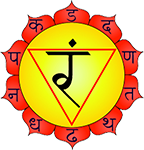
Manipura chakra, situated in the spinal column opposite the navel, is your storehouse of energy. It is the centre of your dynamism: your fire (agni), willpower, self-esteem – and your ego.
In Buddhism, Manipura chakra is acknowledged as the place where Kundalini energy begins its ascent to the brain. It controls the spleen, pancreas, liver, gall bladder and digestive function – and is also related to the eyes and to the feet!
In my December 2009 article, I explained how the three attributes, or gunas, that exist in nature – tamas (inertia), rajas (dynamism) and sattwa (harmony) – influence us all the time.
Characteristics of an overactive (rajasic) Manipura chakra include: feeling courageous and powerful and seeking opportunities to gain more power (also over other people); being competitive in all situations and willing to fight one’s way up the ladder of success; being obsessed by winning – and not able to easily accept defeat.
Very often this picture is dulled or distorted by inertia (tamas). Then a person may begin something but never finish it. They may have a feeling of submissiveness and low energy, which prevents them taking action. Unable to understand how hopes and dreams can be fulfilled, they are always seeking others to tell them how to do it. Yet there is difficulty in relating to others, especially as motivation may be low. The intellect is dull, the digestive system malfunctions, the immune system is weak and there is little courage and energy…
What is needed is more creative intelligence (sattwa)! When Sattwa influences Manipura, one’s action is no longer ego-centered, but directed towards the good of all. There is no longer attachment to the result of our actions and more ability to accept things as they come without mental or emotional disturbance. At the same time, one is now able to achieve everything one attempts to do – the impossible becomes possible! And relationships become easier and based on mutual cooperation and respect for the needs of others.
Evolution
There are endless possibilities to grow and evolve through yoga practice – so let’s look at what might be holding us back!
Disease – that dominates and disturbs the mind.
Dullness – losing the sharpness of your awareness, daydreaming, "spacing out".
Doubt – "I’ve been doing this exercise for so long without any change; should I change the teacher, or do something else?"
Procrastination/putting things off – "I will begin the classes again next week." (Next week there is another thing that intervenes, and this can go on for years.)
Laziness/sleepiness (tamas) – drinking coffee for a short-term solution or partaking in physical activity will remove this.
Craving – "I’d love to eat something, see somebody, experience something, do something other than what I’m trying to focus on now."
Erroneous perception – in higher stages of meditation we might experience visions from the psychic realm and mistake them for spiritual evolution/enlightenment. Thinking that you’ve attained a higher level when you haven’t. The ‘this is it’ illusion.
Inability to achieve finer stages in practice – for example not being able to feel energy flowing through the body, or to visualize anything.
Instability – body suddenly shaking or moving when you try to sit perfectly still for some time, reducing the level of your concentration.
Pain – disturbing/distracting both body and mind.
Depression – instead of feeling light, harmonious and content, becoming subdued and depressed.
"I don’t have time" – (to do a particular thing or to attend classes). The concept of time is very much linked to the mind. And we all know how the mind can work for or against our evolution. It can hold us back in old, vicious circles of action and thought, or move us forwards. Yoga is geared towards enabling us to take responsibility and control of our life as well as our mind. If our ‘mantra’ is “I do not have the time”, then it is clear that we do not have control over our life.
All these obstacles can be eradicated by developing one-pointed awareness of mind, which is the reason I keep asking you to focus on the breath and to visualize a candle flame in the space between you eyebrows!
This list of obstacles was compiled by the sage Patanjali in his book "The Yoga Sutras" written around 400 BC (except the last item, which is my own insight). Human evolution has been unbalanced, and despite huge technological advances we are still struggling on these mental, emotional and psychological levels in the 21st century. So where do these obstacles come from?
The three gunas
In the classes I have been sharing information with you about three ‘attributes’ (tamas, rajas and sattwa) that influence us, nature, the cosmos and everything material in it. They are ‘the three gunas’ and are inherent to all creation (prakriti). All material things fall under the fluctuation of these three elements. They affect us subjectively on a psychological and mental level and objectively via manifestations that take place in the world around us.
Tamas – inertia, lethargy, laziness, resistance, sluggishness, procrastination, the prevention of movement, making us feel "stuck", unchangeable, ignorant, negative, destructive, passive and indifferent. For example if you are experiencing tamas, while you may have the idea that attending classes will help you, it will probably remain just that, an idea without action! Yet the good news is that tamas will also make you feel grounded and very stable, with the ability to focus on one thing (good news or bad news depending on what you are focussed on)! Yet in tamas the consciousness is in darkness, leading to "doom and gloom" patterns of thought and the inability to see the positive side of people and situations.
Rajas – Action, dynamism, vitality, restlessness, agitation, dissipation, instability, uncertainty, fluctuating passions, insatiable desire, worldly ambition, a need for appropriation, greed, enterprise, charity but only for your own benefit (‘what’s in it for me?’) and therefore full of self aggrandizement, pride, hypocrisy, anger and harshness. The good news? This dynamic activity leads to assertiveness, creativity and the motivation to grow and evolve. How many people, situations and institutions express and stimulate rajas?
Sattwa – balance, harmony, calmness, fearlessness and clarity (one knows which direction to take, what has to be done and how), inner luminosity (ajna chakra is active), positive nature, purity in word, thought and action, compassion, a striving to help and benefit others whenever possible without seeking fame, name or reward for doing so. Faith, reverence, devotion, inspiration, self-control and stability in all circumstances. Feeling free and experiencing full mental absorption during meditation.
During your day try to be aware which of these is most active at any given moment, beginning with how you feel when you wake up. How does this change throughout the day? How did what you ate affect the three gunas? Each of us has a dominant guna. Be aware of how the gunas express themselves in the behaviour of colleagues, family, friends, animals, plants and even weather conditions.
During the class pay attention to which physical movements stimulate tamas, rajas or sattwa and to how you feel after the class.
Regular yoga practice, along with development of one-pointed consciousness, will balance the fluctuations of tamas and rajas, allowing you to experience a state of sattwa increasingly often.
Our relationships
Wherever I went, on my travels through Hungary, Croatia, France and England this year, the subject of relationships seemed to crop up everywhere.
How do we feel about our relationships with other people, with ourselves and with the situations around us? It is easy to let our relationships be affected by hurt, jealousy, anger or sadness. It is not so easy to put aside old feuds, to forgive and to try and improve our relationships by concentrating on calming the situation, or the people involved, rather than causing even more irritation. Our pride can cause us to be stubborn when we’ve been hurt; it can be difficult to see things in a new light, or to start again with a clear conscience.
On a micro level we are concerned with the relationship between mind and body. Do they co-exist harmoniously or is the mind forever critical and dissatisfied with the body? On a macro level in the world the major problem is not so concerned with whether or not we can touch our toes! Most of the world’s problems arise from our attitude to something or to someone, i.e. our relationship to that person or thing. But most of these problems are publicized in the light of negative human traits rather than promoting and developing the positive, spiritual qualities. It seems that we can kill our fellow human beings easily enough, but to show unconditional love towards them presents more of a problem.
"The biggest problem is not the warming up of the planet, but the increasing coldness of the human heart." ≈ Paramahamsa Niranjanananda Saraswati
But we can change. Below is a list of observations made by the people attending classes since September last year:
- I exercise more regularly at home
- I experience more depth in everyday life
- I notice I am less fearful
- My powers of concentration have improved
- I am more focused, less distracted
- I no longer have sleepless nights
- I am finally able to do the Salute to the Sun without any resistance!
- I am more aware of the connection between mind and body when it comes to illness
- I am less impatient; able to sit still for longer
- I have more energy and peace of mind
- I know what to do when I am out of balance
- I can stay calm in stressful situations
- My relationships are much better
- I have more empathy and am better able to know what is bothering someone else
- I have more mental clarity and am more decisive
- My lower back no longer troubles me
- I am more energetic at work
- I can feel the flow of vital energy through my body after an exercise
- I experience more physical sensations
- I know which exercises I can do at work
- After years of trying, I have finally stopped smoking
- The two sides of my body are better balanced
- I have been able to let go of old mental conflicts (often family related)
- I have more self-confidence, also in my dealings with others
- My body is much more supple
- I am now able to calm my mind before sleeping
8 stages of evolution
Everyone who has attended a stretch class will be familiar about how to go about maintaining and reorganising the physical body by way of exercises. Yet according to the "bigger picture of Yoga", described by Patajali in the Yoga Sutra’s, written in 400 BC, there are 8 stages of spiritual evolution that each human being can achieve. These are:
- Yamas (5 social codes) and Nijamas (5 personal codes) - that aim to reduce mental and emotional disturbances.
- Asana – physical postures designed to enable you to sit effortlessly and completely still. This has been widely adopted in the western hemisphere and expanded in the way yoga is taught.
- Pranayama – the control, guidance and direction of vital energy (prana, Chi, Ki) in the pranic body (Pranamaya Kosha), leading to mental and emotional balance.
From here on the practices become more internally directed and less concerned with the material level of your existence… - Pratyahara – known as the ability to withdraw sensory attachment and concerns practices such as Yoga Nidra, Ajapa Japa, Antar mouna and Kaya Sthairyam – all of which we have begun to practice in the classes.
- Dharana – the ability to strengthen the concentration to such an extent that you are able to focus exclusively on one point only and without effort. Here the focus still fluctuates.
- Dhyana – at this stage the one-pointedness of attention is experienced as a continuous flow, in which you are conscious of the fact that you are practising, as well as being conscious of the object that you are focusing upon. This is what is called ‘meditation’.
- Samadhi – in this stage one becomes only aware of the object that is being focused upon and there is no longer awareness of your limited self. This is a state called "enlightenment".
BECOMING AND EXPRESSING
So in these 8 stages we are evolving and becoming.
The aim of the "18 ities" of Swami Sivananda is to enable you to live and express yoga, by integrating these attributes into all your daily actions and thoughts, rather than just being limited to the attendance of the weekly class. These attributes are as follows:
Sincerity; regularity; (freedom from) vanity; sincerity; simplicity; veracity; equanimity; fixity; non-irritability; adaptability; humility; tenacity; nobility; magnanimity; generosity; charity; integrity; purity.
Swami Niranjananada decribed this as a way to "update you mental software". A way to leave all the old patterns of restrictive thinking and behaviour behind, to move on and become more free to see more of the total picture of life. Over the years that I’ve been teaching I’ve noticed that most people attending the classes were not struggling so much with physical stiffness, but more often the mental stiffness were the most restrictive. By this I mean the inhibitions, doubts, lack of faith/self confidence, anxiety and fears, that limit and block the ability to move forward, to evolve. After all have you ever met anybody on this planet that does not want to feel and be more free, be less burdened by the past and less worried about the future ?
So the "18 ities" concern 18 attributes that you can perfect within yourself, that will "update your mental software" and lead you along the path of greater harmony and freedom.
How does your garden grow?
Dear stretchers and potential stretchers,
Often when someone asks me what I do for "work", I reply that I’m a gardener. What on earth (sic) has gardening to do with Holistic Yoga & Shiatsu Therapy, you may ask? One of the most important elements in gardening is that there is earth present (similar to the material body). Another aspect of gardening is that the earth is able to allow air to enter into it (similar to the respiration system). Another aspect of gardening is that water is able to circulate through it (similar to the blood circulation). These things must be present – along with mineral content, similar to the digestive system – in order to have a good-quality earth that can allow things to catalyze, germinate and grow. We need to be prepared to invest through time, effort, patience and care so that these processes can take place and that what grows will be healthy, strong, and resistant to dis-ease (similar to when we stretch regularly).
Perhaps this is why not everybody likes to garden! While there has been a significant increase in the number of people regularly attending stretch classes, which reflects the willingness to invest time, care, effort and patience, many people are struggling to create a space to work regularly on themselves (gardening). Life can present us with a host of problems and difficulties – I prefer to call them ‘challenges’. It is easy to become overpowered and lost when confronted with these challenges. Yet my own experience has been that regularly removing imbalances in the body leads to a reduction in the amount of resistance experienced towards coping with challenges in my life.
Regular balancing of the body also balances the mind and emotional fluctuations, allowing you to think and to act more clearly, more calmly and in a way that prevents the recurrence of tensions in the future. However, in order to progress to this stage we need to acknowledge, understand and remove the root cause of what is causing the imbalance and the tension in the first place. For instance let us look at the way in which emotions are connected with the various different meridean energies that flow (or don’t flow properly) throughout your body.
The energy connected with the following organs:
- lungs – sadness
- heart – joy
- liver – anger
- kidney – anxiety
Balancing these energies changes the way you feel. In the coming Newsletters I am repeating a series of articles that discuss the characteristics of the 12 meridean energies in your body.
If you wish to remove weeds from your garden and you cut only the part of the plant that is visible above the surface (similar to that which is conscious) and leave the roots (similar to that which is unconscious) in the ground, then certainly, in time, the weeds will once again appear.
In the same way, if you experience your life as "survival", if you are having a hard time coping with challenges, then you can meditate, stand on your head for hours or whatever, but when you go home the challenges have to be faced and be dealt with. Stretching will help you to develop the strength and the willpower to deal with these challenges, because it will increase the faith that you have in yourself and in your ability to cope.
Unfortunately the mind very often sabotages this process. The mind has become established in certain patterns of thinking, which lead to action and reaction. Watch the way your mind works and you will become aware that it does not like have these patterns of thinking disturbed. So the mind will reject what it does not like, and hunger for what it likes. This process can be observed during a stretch class.
When I began to stretch, 18 years ago, there was very little that my mind liked! Everything was an effort. I felt resistance to everything and I was easily disturbed by a lot of things, both inside the class as well as outside, in my life. Yet at the end of my first class something told me that if I stopped stretching, if I ‘closed the door’ on what I’d become more conscious of and walked away, then I would take all the tensions and resistance with me, and they would continue to affect me in the way I led and experienced my life – much in the way that many people take their tensions with them on holiday, only to return as stressed as when they set off!
Over the years, the resistances and tensions that I experienced in the beginning have been reduced by at least 90%. The amount of times that I experience dis-ease has been greatly reduced. And my mind is no longer so obsessed with rejecting what it dislikes and chasing after what it would like – a change that has brought about a deep peace of mind. Increasingly I experience pleasure that is not dependant on obtaining something. I’m now able to go with the flow of things, and to let go of what I do not need, much more easily. My attention is increasingly able to remain focused on the present and not so much in the past or in the future. I am now able to be aware of and to accept reality, rather than lose myself in ideals. I feel much more and think increasingly less (which can be a problem sometimes !).
We live in a world where the search for gratification and quick results, rather than awareness of the long-term consequences of our actions, is being promoted as a new religion. With the willingness to stretch regularly (to do the gardening), you will certainly be preparing your ground, sowing the seeds, feeding yourself with love and care and eventually you will be able to reap the benefits that I am beginning to reap now. As I grow older, the flowers in my garden are increasingly beautiful.
The Menopause
Every woman goes through a phase in her life called "the menopause" or the "change of life". For most women, this occurs between the ages of 40 and 50. During the menopause, a woman’s body changes both physically and energetically.
Two hormones that play an important role in a woman’s development are progesterone and oestrogen. Progesterone is the "mother" of all hormones. It has the ability to be converted into other hormones should the body need them. This hormone is secreted by the ovaries. Oestrogen plays an important role in the development of female characteristics, regulating the menstrual cycle and during pregnancy.
During menopause, the hormonal system is out of balance. Symptoms can vary from hart palpitations and hot flushes, to night sweats and emotional swings or mood changes. It can also cause heart problems and vascular disease as well as osteoporosis.
The menopause is a natural process for women and is certainly not an illness. However, it is often regarded as such in the West. Resistance to the menopause may have to do with resistance to the female ageing process. Also, the standards and values that prevail in today’s society influence the way we view the menopause. The pharmaceutical industry plays a role here too, confirming our attitudes. Furthermore, society tends to regard menopause, and indeed pregnancy, as things that get in the way of our working lives (as oppose to our lives).
In countries such as Japan, China and India, women seem not to suffer from menopause-related symptoms. This could have something to do with the women’s diet, but also with how they feel about growing old – women rank higher in status the older they get in these countries. This could lead us to believe that the way women think, how they view their own ageing process and their own menopause, influences the way they experience the change of life.
In Eastern medicine, the menopause is associated with certain energies in the body – the kidney energy, spleen/pancreas energy and liver energy. Liver energy is associated with the purification of the blood and the conversion of food into energy. Spleen/pancreas energy regulates the digestion and is associated with the body’s hormonal balance. Kidney energy regulates bone growth. All these energies decrease during menopause, causing bones for example to become more brittle. Spiritually speaking, kidney energy is related to wisdom, which can deepen during menopause.
So what is the best way for women to handle this change of life? Lifestyle, in particular dietary factors, influences the intensity of the symptoms. Adjustments to lifestyle can therefore help to ease the symptoms.
Some tips
Regarding diet:
Eat a balanced diet; eat food that is easily digestible, contains natural ingredients and includes all essential elements. Such a diet would include fresh vegetables and fruit, pulses, grains, fish (especially oily fish such as mackerel, sardines, tuna etc.), nuts (especially walnuts and almonds), soya products, oils, herb- and fruit-teas. Food that has been produced naturally is much richer in minerals and vitamins than ‘treated’ food that has been subjected to chemical processes and pesticides. And don’t forget natural sweeteners such as rice- maple- and date-syrup. These all help strengthen the immune system.
Following a diet according to your blood group is also worth considering. Certain blood groups such as O or A may be sensitive to a particular food, such as cheese.
Eating slowly and chewing food well helps the body to absorb nutrients. It is also important to drink a minimum of 11/2 litres of water of day.
Herbs can also help alleviate the symptoms of the menopause.
Helpful herbs include:
Sage, which can alleviate night sweating, depression, shakiness and dizzy spells. Sage also stimulates the production of oestrogen, helps reduce hot flushes and is rich in calcium.
Ginseng is good for the body’s hormone balance and for the heart. It is widely used to alleviate symptoms of the menopause.
Stinging nettles strengthen the bones and the heart, and restore the functioning of the kidneys and adrenal glands.
This is just a selection of herbs that may help during menopause. They should always be used in moderation and one herb should never be drunk in large quantities. Varying your intake will lead to a balanced use and more effective results.
It is best to avoid cows’ milk. Milk and cheese contain a protein that is difficult for the human body to absorb. Traces of it remain in the intestines, which can lead to mucus formation and a reduction in the absorption of potassium through the mucus membranes. This places a huge demand on the digestive system’s energy resources. The body can obtain all the calcium it needs from green vegetables.
Other products that can have an adverse effect on the body during the menopause are: sugar, red meat, coffee, cocoa, black tea, alcohol and nicotine. Alcohol affects the blood sugar level in the body. Research has shown that women who smoke enter menopause earlier than non-smokers – the ovaries of smokers produce less than those of non-smokers.
The pharmaceutical industry puts a lot of pressure on doctors to sell its products, such as Premerin, one of the highest sellers amongst synthetic drugs in the US. Unfortunately, little energy is put into the development of natural medicines, because it is forbidden by law to take out a copyright on natural hormones. There is no profit to be made in the pharmaceutical industry investing in such development.
It goes without saying that stress and high expectations (lots of "musts") will exacerbate menopausal systems! It is important therefore to get enough sleep, and to sleep deeply. Physical exercise (such as yoga, stretching or T’ai Chi) will also help, as will massage, such as Shiatsu.
As I’ve mentioned, herbs can offer great relief during the menopause. They are a natural product without side effects. Recommended books include: Marilyn Glenville "A Natural Alternative"; Susan Weed "Menopausal Years" and "Healing Wise"; Annemarie Colbin "Food and Healing".
The following positions alleviate the symptoms associated with the menopause
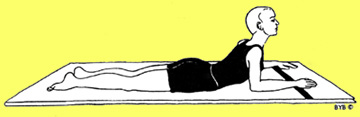
sphinx yoga shoulderstand yoga
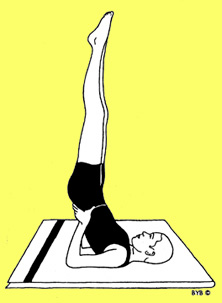
(The above exercise in which the body is inverted should not be done immediately after eating, while menstruating, if you have a brain tumour or have had a brain haemorrhage or are suffering from high blood pressure.)
The Salutation to the Sun
The Salutation to the Sun awakens the sun energy in us (our masculine side, or "Pingala nadi"). There is also an exercise, Salutation to the Moon, which awakens our moon energy (our feminine side, or "Ida nadi"). In the Salutation to the Moon, one leg is lifted and stretched, as in position number 5 (Parvatasana: the "dog" or "mountain"). The more widely known Yin and Yang (Yin symbolising the moon, and Yang the sun) also illustrate the importance of these two influences.
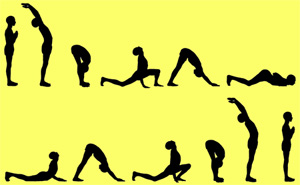
It is well known that regular practice of the Salutation to the Sun eases the following complaints: acne, boils, anaemia, loss of appetite, burn-out, overeating, slow general development, varicose veins, rheumatism and painful joints, headaches, asthma and other lung afflictions, indigestion, constipation, kidney problems, skin complaints (eczema, psoriasis, leucoderma), colds, hormonal imbalance, problems associated with menstruation and the menopause, as well as mental disorders such as panic attacks, depression, neurosis, psychosis and many more.
Practising the Salutation to the Sun
I first came across the Salutation to the Sun at the Bihar School of Yoga, which I attended in 1992. It was the first exercise we did in our morning class, at 4 o’clock each morning. It was done at a very brisk tempo – 1, 2, 3, 4, – without any further guidance.
Before you start the exercise, stand up straight and let your whole body come to rest. Become conscious of your entire body, starting with your feet and slowly moving your attention upwards so that you become aware of how each part of your body feels. As you move through the different positions you should never force yourself; each new position should follow smoothly on from the last. Do not continue if you feel yourself becoming exhausted.
The best time to do the exercise is at sunrise, but most of us get up later than that. Whenever you do it, it should never be later than early evening. Do the exercise on an empty stomach, at least three or four hours after eating.
The Salutation to the Sun should not be practiced by people with high blood pressure, by those who have widened or narrowed arteries around the heart, or by those who have recently suffered a heart attack. Additionally, if you have a hernia, or tuberculosis, you should also avoid this exercise. If you are suffering from sciatica or a slipped disc, this exercise could exacerbate the symptoms. Pregnant women may practice this exercise up to the 12th week of pregnancy, and can resume the exercise 40 days after the birth.
Yogic breathing during the exercises
Breathe in as you raise your head, and out when you lower your head. If you practice the Salutation to the Sun at a fast tempo, it will stimulate the flow of energy in the Pingala nadi (‘nadi’ are energy paths, rather like meridians). The Pingala nadi are located in the right hand side of the body, and represent Yang energy.
Practising the exercise more slowly will allow more time for the development of our mental faculties (our ‘Ida’ side). It is said that this will increases our spiritual development. Pingala energy is responsible for extrovert tendencies. It stimulates the central nervous system and represents our positive, dynamic and mental sides. According to Karl Jung, Pingala is our conscious personality, rational and discerning. Overstimulating the central nervous system will increase blood pressure and the elimination of acids, and could lead to the formation of stomach ulcers, angina and the constant production of adrenalin; this leads to ‘fight or flight’ behaviour.
Ida energy is responsible for our introvert tendencies. It gives us knowledge and consciousness of the world around us. If Ida energy dominates, a person will tend to be a daydreamer, with lots of plans, but without the ability to realise them. He will also be over-conscious of his feelings and oversensitive to events outside himself and to his experiences with others. Because the introvert does not have enough energy to carry out her plans, she may become constipated, depressed, and fearful and may suffer from eczema, inflammation of the large intestine and an array of psychosomatic disorders.
The above descriptions may give you an idea of which energy is most prominent during your waking hours. Take note of any changes that might occur after you have practiced the Salutation to the Sun; regular practice should bring about a balance between Pingala and Ida energies. Today’s society is an extrovert one, with little time for introspection. Regular stretching, including practice of the Salutation to the Sun, is a wonderful way to make contact with our inner selves.
The positions

Position 1 Pranamasana (prayer position)
Mantra: Om Mitraya Namaha (Salutations to the friend of all).
- Your attention should be focused towards your chest.
- This will automatically turn your gaze inward, focusing your attention and stimulating the necessary calmness for practice of the exercise.
- Focus your attention on your heart chakra (anahata).

Position 2 Hasta Utthanasana (position with arms upheld)
Mantra: Om Ravaye Namaha (Salutations to the shining one).
- Improves the digestion by stretching the organs in the abdominal cavity.
- Exercises the muscles of the arms and shoulders; balances the working of the nerves in the spine; maintains the sponge-like consistency of the intervertebral discs; opens the lungs and removes excess fat (by influencing the working of the thyroid gland).
- Prana (vital energy) moves upwards through the body.
- Bring your attention to the throat chakra (vishuddi).

Position 3 Padahastasana (position of hands to the feet)
Mantra: Om Suyaya Namaha (Salutations to he who induces activity).
- Alleviates stomach and bowel complaints, reduces excess fat in the stomach region, improves digestion, massages the liver, kidneys, gall bladder, pancreas, uterus and ovaries; helps regulate irregular menstruation; eases constipation; improves the circulation; increases suppleness of the back; balances the working of the nerves; stretches the groin and the muscles in the sides; helps varicose veins and pumps fresh blood to the heart. N.B. Those with back complaints should bend the knees slightly.
- Prana is sent to the lower parts of the body.
- Put your attention on the swadisthana chakra at the base of the spine.

Position 4 Ashwa Sanchalanasana
Mantra: Om Bhanave Namaha (Salutations to he who illuminates).
- The ankle of the bent leg should be directly under the knee; the hips should be as close to the ground as possible.
- This position massages the organs in the abdomen and improves their functioning.
- It strengthens the leg muscles, balances the central nervous system and helps to keep sinus cavities open.
- Keep your attention on the ajna chakra, between the eyebrows. The ajna chakra is directly linked to the mooladhara chakra, behind the neck of the uterus in women, and in the perineum in men.

Position 5 Parvatasana (Mountain, or Dog position)
Mantra: Om Khagaya Namaha (Salutations to the one who moves quickly through the sky).
- Strengthens the nerves and muscles in the arms and legs, eases varicose veins, balances the working of the nerves in the spine, straightens the back, stimulates blood circulation in the upper back and between the shoulder blades.
- The thyroid is stimulated by keeping the chin close to the chest.
- Bring your focus to the vishuddi chakra, just below the collarbone, near the throat.
- Every time you breathe out, prana is directed downwards.

Position 6 Ashtanga Namaskara (eight-part greeting)
Mantra: Om Pushne Namaha (Salutations to the giver of strength).
- Strengthens the chest and the muscles in the arms and legs, exercises the area between the shoulder blades.
- Prana moves downward to the stomach area.
- Bring your attention to the manipura chakra in the spine, opposite the navel.

Position 7 Bhujangasana (Cobra position)
Mantra: Om Hiranya Garbhaya Namaha (Salutations to the golden, cosmic self).
- Improves circulation and suppleness in the back, balances the working of the nerves in the back and the eliminatory organs (e.g. the liver), stimulates the digestive system, eases constipation, massages the kidneys and pancreas, helps asthma.
- Attention should be focused on the swadisthana chakra, at the base of the spine. Prana is sent upwards.
Now you go through the positions again, working backwards; position 8 is the same as position 5. The mantras are different:
Position 8 Parvatasana (see position 5)
Mantra: Om Marichaye Namaha (Salutations to the rays of the sun).
Position 9 Ashwa Sanchalanasana (see position 4)
Mantra: Om Adityaya Namaha (Salutations to the son of Aditi [the cosmic mother, Mahashakti]).
Position 10 Padahastasana (see position 3)
Mantra: Om Savitre Namaha (Salutations to the stimulating power of the sun).
Position 11 Utthanasana (see position 2)
Mantra: Om Arkaya Namaha (Salutations to he who is fit to be praised).
Position 12 Pranamasana (see position 1)
Mantra: Om Bhaskaraya Namaha (Salutations to the one who leads to enlightenment).
Yogic Breathing after the exercises
When you have completed the exercises it is important to lie on your back, arms next to your body with the palms facing upwards; lengthen the neck and lower back by tilting your hips towards the floor and bringing your chin towards your chest.
When you have become conscious of the movement of your navel with each breath, breathe in deeply, first filling your abdomen and then your chest, for the next 15 breaths. When you breathe out, empty your chest first and then your abdomen. Always breathe through your nose, and breathe slowly. When you have done this 15 times, focus your attention on your navel again. Without changing your natural breath in any way, breathe in and out 35 times. If you find your attention wandering, simply bring it back to your navel.
Finally, I would love to hear from those who practice the Salutation to the Sun regularly. What influence do you feel it has? e-mail Holistic Yoga with your experience.
Adaptable mind, flexible body
Traditional Chinese medicine maintains that dis-ease occurs when the body and mind can no longer adapt to change, challenge or threat. When the body is unable to adapt to changes, to traumas for example or to bacterial attack, dis-ease arises. When we cannot adapt to change (crises, threats, insecurity and fear around us), the internal environment of the body and mind also becomes disrupted. This places a huge strain on all body functions and leads to the formation of serious malfunctions (e.g. stomach ulcers, high blood pressure, allergic reactions, asthmatic or anxiety attacks, sleeplessness, headaches, migraine, constipation, eczema and many other symptoms).
The body has a tendency to become more fragile and less flexible, as we grow older. My own experience of regular stretching however, is that my body has become both stronger and more flexible as I grow older! With age, the mind can also become less flexible, clinging onto habits and trusted ways of thinking, avoiding anything that may seem different. This is a process I have witnessed firsthand in the people around me.
It seems to me to be so important to keep the mind open and flexible, in spite of the thousands of memories of past experiences, of pain or hurt that can dictate how we react to a person or situation today. It is crucial, if difficult, to try to greet situations and encounters with a fresh, open mind, rather than with all the memories of the past. In this way we keep the mind young and open to new thoughts and experiences.
If you look at the world around you, you will see hundreds of examples of struggles between people, which are caused by fanatically clinging on to old wounds; where both sides are blinded by traditional ways thinking and doing.
So stretching is not just about being able to adapt to new physical positions. It is not just about learning to let go of physical tension and resistance, but perhaps more importantly, it is about being able to let go of ‘mental stiffness', about embracing change and challenge rather than seeking ways to run away from them.
The mind - friend or foe?
Buddha is quoted as saying that the body is a reflection and an expression of the mind. The mind is a collection of memories, impressions and patterns of behaviour. Each time you experience something the mind reacts according to whether it has had a similar experience previously, if it has not, then it stores up information for future reference. The body, along with its many physiological functions, is affected by what the mind experiences. For example, when you are angry the body becomes hot, the heart beats faster, the veins open up allowing more blood to circulate and the breathing changes. This can only be considered 'pathological' when you hold on to anger, or sadness, for a long period.
During the years that I have been stretching, I have observed that it is not only my body that has learned how to let go of old traumas, but that my mind also can more easily adapt to changes, to disturbances and to disappointments. I have become more emotionally balanced and fall ill a lot less than I used to. Stretching has made me more supple both mentally and physically. I have seen the same process occur in many of the people who attend the stretch classes, in the same way that I have watched the increasing physical and mental inflexibility of those around me who do not stretch regularly.
In a world in which we are encouraged to be what we are not, to exceed our limits in our endeavours, at work or at home, I see how essential stretching is for a greater degree of harmony, both within and without. More importantly, stretching gives you the choice of how you want to feel about yourself and about your life. The world around takes on another perspective when you are feeling balanced, strong and flexible.
But very often the level of conflict within ourselves, and in the world around us, takes on such proportions that the slightest change can lead to panic and more confusion. The balanced feeling you experience after a stretch class will not stay with you if you do not make stretching a regular occurrence, in the same way that you sleep and eat regularly. Also, the resistance or pain that you may experience in some of the positions will not disappear just by deciding not to practice those positions. It will merely return to the background and become unconscious once again. My own experience, as well as those who have been stretching regularly, is that pain and resistance go way when you are not afraid to look at them and understand how they are being maintained, and find out why you have given them a place in your body and mind in the first place. The electrical impulse for pain is exactly the same as that for pleasure. It is the mind that translates the impulse into one or the other.
Many people in the world feel very insecure; uncertain about the direction their life will lead them, and are afraid. One thing we can all influence or change is the way we feel, think and act. We are the captains of our own ship and, in the words of Nelson Mandela, "It is our light, not our darkness that most frightens us".
Putting Thought into Action
If all the people who told me how wonderful and important stretching was, regularly attended classes, the Amsterdam Arena would not be big enough to hold them all! So let us look into the gap between thought and action.
Over the years I have observed that human consciousness appears to increase and decrease in the same way as a wave on the ocean. This can be seen in the way the world (the collective consciousness) reacts in times of war and disaster. Dramas, insecurities, pain, sadness, 'accidents' and heartbreaks cause us to reflect on ourselves, our life and our relationships with others. When somebody dies ('leaves their body') we think not only about their life, but also the meaning and quality of life in general. Dramas shake us out of our comfort, our need to be fulfilled, gratified and entertained.
The numbers attending stretch classes increase each year in spring, September and January. A wave of people with the resolution to do something, change something or find something. Just as each wave on the sea returns most of the pebbles it washes up, back into the sea again, in a similar way, the majority of people drift in and out of the classes. These fluctuations reflect our link with nature (the surge of activity in spring, related to the liver energy) and our need to prolong the feeling of relaxation and balance after a holiday (related to the stomach and spleen/pancreas energies).
The way we live our lives can be stressful and demanding, or it can be balanced and inspiring. When we go away on 'holy-daysí we experience a new environment; being able to choose what to do, and how and when to do it; the feeling of having free time. Feeling unable to make choices can lead to mental and physical tension, to a feeling of being trapped. Our concept of time is related to how much what we do pleases or interests us. We are all conscious of time when we have to do something we do not like. Many people feel that a two-hour stretch class is too long, indicating that they have a preconceived idea of what a stretch class should be like; it can also indicate the degree of mental/physical resistance to what they are going to do.
The conflict between the one who wants to change something and the one who would rather let 'sleeping dogs lie' is familiar to all of us in one way or another. The mind, being made up of past recollections and pre-conditioned patterns of response, does not like to be disturbed, and seeks comfort and gratification.
A few examples of the way the mind shapes thought and action are:
- A person who pays for trail lesson, saying that they would like to see how they feel during the week, before coming back again, can be compared to a person saying that they will take a shower, brush their teeth or eat a healthy meal once, then wait a week to see how they feel! Energy needs to move around the body. When it stagnates, "dis-ease" develops and the way we feel about ourselves changes.
- Another person says that they would return to the class if and when they felt like it. Who is the person who feels and thinks? What are the factors that influence thought and feeling and where do they come from? Regular attendance in the classes will help to answer these questions!
- The "garage mentality". Something malfunctions in the body, so the body is hauled off to be "repaired". Parts are taken out, things get changed around and the person is then able to continue their "unbalanced" life, until the next problem arises. Yet unlike a car, the body cannot be replaced (yet!). We have all been brought up to this way of thinking.
- A person who stopped attending the classes years ago states that he has been "healed" and will return again only if something begins to malfunction. The whole medical system in the West functions on this principle.
Of course one aspect of stretching concerns the healing of things that malfunction in the body. Surely even more important is understanding why something goes wrong in the first place and learning how to prevent it going wrong in the future. Regular stretching enables us to study how we give 'dis-ease' a place in the body and the mind. This leads on to the study of who we really are and the awareness of who we think we are. This can change not only the way we act and think, but also the nature of our relationship with others.
Around 4,000 years ago, a famous yogi, Patanjali, listed the obstacles that stand in the way of regular and consistent yoga practice. These were:
- Vyadhi - sickness disturbing the physical equilibrium
- Styana - languor or lack of mental disposition for work
- Samsaya - doubt or indecision
- Pramada - indifference or insensibility
- Alasya - laziness
- Avirati - sensuality, the rousing of desire when sensual objects possess the mind
- Bhrani Darsana - false, invalid knowledge, or delusion
- Alabdha Bhumikarva - failure to attain continuity of thought or concentration so that reality cannot be seen
- Anavasthirattva - instability in holding on to the concentration that has been obtained after long practice of yoga.
- Duhkha - pain or misery
- Daurmansya - despair
- Angamejayatva - unsteadiness of the body
- Svasa prasvasa - unsteady respiration
I would like to add one more - lack of faith in yourself. Without faith, continuity or further development in what you attempt will be greatly impeded. Regular stretching strengthens both faith in yourself and willpower. All human beings deserve the best. Yet our thoughts and actions often prevent us from achieving the best. If the times of the classes do not fit into your schedule, make space for yourself, for example by asking your employer if you can leave earlier to attend the class. Recently a few students were subsidised to attend the classes by their employer. It is in the interests of your employer that you remain healthy. A monthly stretch card costs much less than a number of years in the WAO !!
When I began stretching in 1983, I was very stiff and often had a lot of muscle pain after the class. My teacher (Jonathan Shaw) told me thousands of times that if I softly repeated the stretch movement that gave me the muscle pain, it would go away. These wise words went in one ear and out of the other for many years, until one day I did what he told me to do and the muscle pain was gone within 15 minutes! It was lack of faith in myself that had prevented me doing this many years earlier.
Mankind has achieved and is continuing to achieve fantastic, awe-inspiring developments in science, electronics and cybernetics, the likes of which would have astounded our ancestors. Yet looking around the world, the wars, killing in the name of God, country or ideal and the disgusting gap between rich and poor, one may ask if mankind has undergone any psychological change at all. The 'head' is being developed at the cost of the 'heart'.
The need for a different way of thinking and acting is urgent if we want to secure a healthy future, not only for ourselves, but also for the planet, which sustains our existence. The changes I see taking place in the people who attend classes regularly, their increasing mental and physical freedom, strength and balance, gives me the hope that our world, both inside the body as well as outside it, is beginning to change.